


Two different working methods and their advantages and disadvantages of laser cladding process
Contact Info
- Add:西安市国家民用航天产业基地航天基地299号西安建工科技创业基地十号楼4层, Zip:
- Contact: 段纯
- Tel:17392761868
- Email:gsjgkj@163.com
Other Products


I. Two-Step Method for Laser Cladding Process (Default Method)
This method involves placing the cladding material onto the workpiece surface before performing the laser cladding process, then using a laser to melt and solidify it to form the cladding layer.
Methods for pre-placing the cladding material include:
1. Pre-coating: Manual application is generally the most economical and convenient. After the workpiece surface is dried, laser cladding is performed. However, this method has low production efficiency, inconsistent cladding layer thickness, and is unsuitable for mass production.
2. Pre-placed sheets: A small amount of binder is added to the cladding material powder, which is then molded into sheets and placed on the areas of the workpiece requiring cladding. Laser treatment follows. This method offers high powder utilization, stable quality, and is suitable for deep-hole components such as small-diameter valve bodies. High-quality coatings can be achieved using this approach.
II. One-Step Method for Laser Cladding Process (Synchronous Method)
This process involves delivering the cladding material to the laser-active zone simultaneously while the laser beam irradiates the workpiece. There are two methods:
1. Synchronous powder feeding: A specialized powder injection device is used to feed single or mixed powder into the molten pool. The cladding layer thickness is adjusted by controlling the powder feed rate and laser scanning speed. Due to the high absorption rate of loose powder to laser energy and high thermal efficiency, thicker cladding layers can be achieved compared to other methods, and automation is easily realized.
2. Synchronous wire feeding: The process principle is the same as synchronous powder feeding, except that the cladding material is pre-processed into wire or filled wire. This method is convenient, minimizes material waste, and ensures better uniformity of the cladding layer composition, especially for composite materials. The quality of the cladding layer is not affected by differences in powder specific gravity or particle size. Preheating and fine processing of the wire can improve the cladding rate. However, the smooth surface of the wire reflects laser light strongly, resulting in relatively low laser utilization. Additionally, wire manufacturing is complex, with limited varieties and specifications.
III. Intelligent Equipment Technology for Synchronous Powder Feeding in Laser Cladding
As one of the core components of cladding equipment, the performance of the powder feeding device directly affects the quality of the cladding layer. With the rapid development of laser cladding technology and increasing demands for processing precision and quality, developing high-performance powder feeding equipment is particularly important for laser cladding applications.
To address this, Xi'an Guosheng Laser Technology, leveraging its leading technical and R&D capabilities, has developed an intelligent high-precision synchronous powder feeding device suitable for ultra-high-speed laser cladding. This series of intelligent powder feeding devices is designed to meet the precision requirements of both conventional and ultra-high-speed laser cladding. It maintains stability during high-power, high-powder-feed operations while also excelling in precision applications with its unique micro-powder feeding functionality.
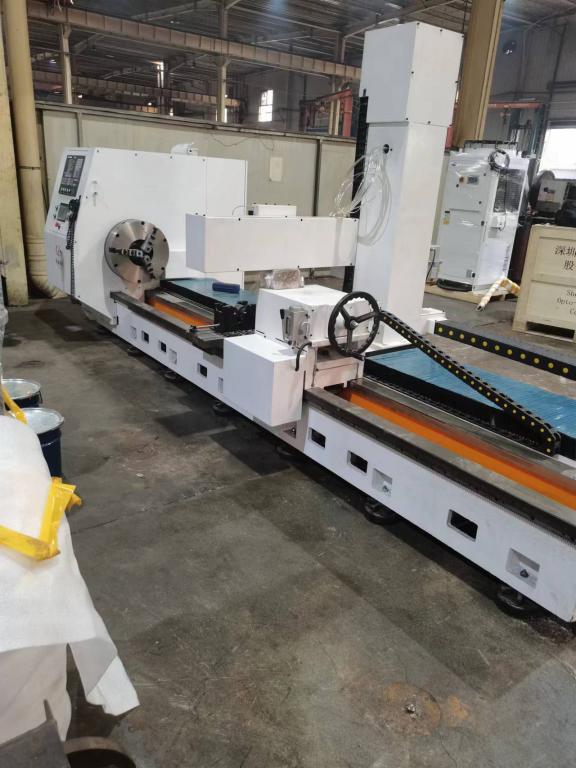
The single-station cladding and quenching equipment features a fully HT-cast bed, ensuring structural stability and high vibration damping. PLC control provides a "user-friendly" human-machine interface, and the four-axis mechanism (X, Y, Z, rotary axis) enables联动. The single-station design is simple in structure and easy to operate. The fully water-cooled cladding/quenching head allows for 24-hour continuous operation. The equipment supports a maximum swing diameter of Ø600 mm, a maximum workpiece length of 3000 mm, and a maximum load capacity of 3 tons. It can perform external cylindrical cladding/quenching on shaft and disc components, as well as internal hole cladding/quenching.
Currently, laser cladding technology is rapidly developing and maturing, moving toward widespread application. As a key supporting technology for green remanufacturing, it represents a high-tech field aligned with national sustainable development strategies. Chinese scientists have achieved internationally advanced levels in fundamental theoretical research, making significant contributions to the development of laser cladding technology. However, the application level and scale of laser cladding technology still fall short of market demands. Addressing key technologies in engineering applications, developing specialized alloy powder systems, creating dedicated powder feeding devices and techniques, systematically studying non-destructive repair methods, and establishing quality assurance and evaluation systems are critical. With intensified efforts and cultivation of reliable engineering applications, laser cladding technology holds immense potential in today's increasingly competitive manufacturing market.
| Industry Category | Others |
|---|---|
| Product Category | |
| Brand: | 国盛激光 |
| Spec: | |
| Manufacturer: | 西安国盛激光 |
| Origin: | 116101 |


